
Underground by Trade - Elevated by Choice
Bravo Civil Infrastructure Services
Land Clearing · Mass Grading · Demolition · Stormwater · Sewer · Fire · Water · Concrete Flatwork · Power · & Fiber
One contractor, self-performing the entire infrastructure scope — from site clearing to finished pad, ready for vertical construction.

Large new-construction projects lose time at the seams between trades. Bravo removes those seams: one company, one schedule, and one point of accountability for every infrastructure scope a site needs, wet and dry alike. No coordinating a dozen subcontractors, no gaps between who owns what — just a single team carrying the project from mobilization through turnover.
Predictable project delivery
Fewer surprises start before mobilization.
Every opportunity begins with a thorough bid review and a site walk. The objective is to surface access limits, existing conditions, utility conflicts, trade interfaces, and missing decisions before they become field changes.

-
01
Review the full bid
Plans, specifications, addenda, quantities, schedule, and scope boundaries are compared before pricing so assumptions stay visible and avoidable change-order exposure is reduced.
-
02
Walk every site
Bravo conducts a site walk for every job it bids, documenting access, logistics, existing conditions, and constraints the drawings may not show.
-
03
Plan to the commitment
On-time, on-budget delivery is the operating target. Schedule and cost risks are raised early against the agreed scope instead of waiting for them to reach the field.
-
04
Coordinate adjacent trades
Field planning accounts for other subcontractors, shared access, inspections, crossings, and release priorities to minimize preventable conflicts.
-
05
See bottlenecks early
Project information and scheduling tools help the team identify bottlenecks, share current issues, and protect the next critical milestone.
-
06
Keep one communication loop
The site superintendent, project management team, and office stay connected so schedule changes and field issues are addressed promptly.
Core capabilities
One field plan for the work that makes the site buildable.
Utility, earthwork, lift-station, concrete duct-bank, and restoration decisions overlap. Bringing those interfaces into the bid conversation early gives the project team a clearer scope and a more workable sequence.
01

Underground Utilities
Water, sewer, and storm drainage scopes coordinated around access, testing, inspections, and the project schedule.
02

Site Development / Earthwork
Clearing, excavation, fill, grading, and pad preparation planned around drainage, utilities, access, and vertical construction.
03

Lift Stations
Civil, utility, structural, electrical, controls, testing, and commissioning interfaces organized around one turnover path.
04

Concrete Duct Bank
Concrete-encased conduit pathways coordinated around excavation, structures, utility interfaces, inspections, and the project schedule.
05

Directional Drilling / Boring
A project-specific review of trenchless crossings, existing utilities, access, bore geometry, materials, and restoration limits.
06

Concrete Flatwork & Surface Restoration
Confirmed concrete-flatwork capability coordinated with grading, utilities, accessibility, finish requirements, and project-specific surface restoration.
07

Street Lighting
Street-lighting installation coordinated around pole locations, foundations, underground pathways, electrical interfaces, access, testing, and restoration.
08

Electrical Conduit Installation
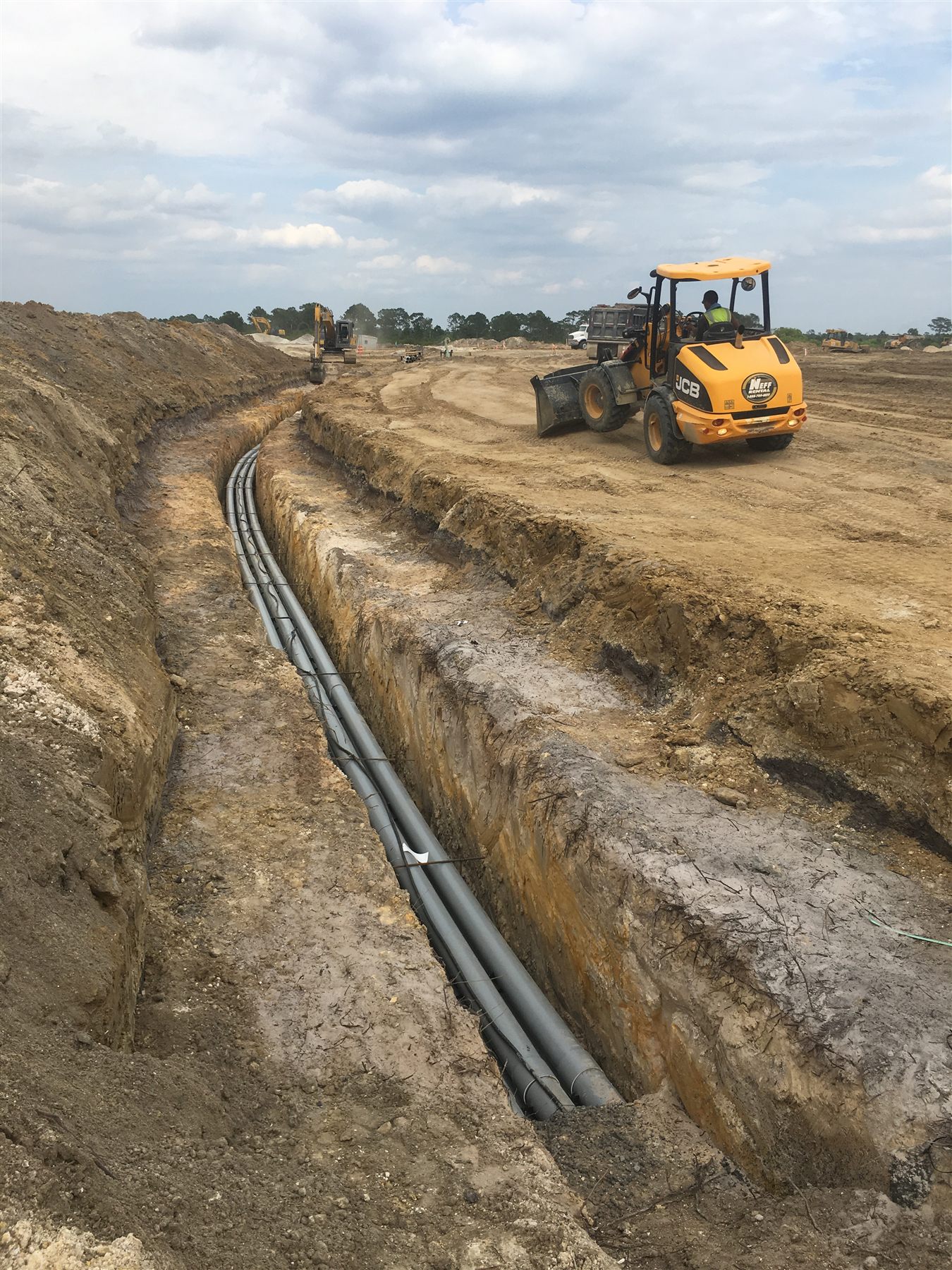
Underground electrical conduit pathways coordinated around routing, bends, access structures, utility interfaces, testing, backfill, and turnover.
Also available
Additional scopes and work conditions.
- Complete Fiber Installation
- Demolition
- Land Clearing
- FDOT Work
- Right-of-Way Work
- Night Work
- Underground Stormwater Retention Systems
- Gas Installation
Recent job experience
Recent job sites.

David Lawrence Center Expansion

Fort Myers Deep Injection Well

Lee Health
JW Marriott

Creative World

Fifth Third Bank

Alva School

Punta Gorda Airport
Wellen Park
Babcock Ranch

Lakewood Ranch

Oxford Landing
Safety as culture
Everyone has the authority to pause the work.
Safety is part of how Bravo plans and performs the work. Dedicated oversight, independent field review, role-appropriate training, competent-person designation across field teams, and stop-work authority keep concerns visible and actionable.
Dedicated safety manager
Dedicated safety leadership supports planning, field expectations, follow-up, and communication across the organization.
Third-party field review
Independent field inspections and audits add another check on site conditions and program execution.
Role-appropriate OSHA training
Crew and supervisory personnel maintain OSHA training credentials appropriate to their assigned roles.
Right to stop work
Team members can pause work when a hazard or changed condition needs evaluation before operations continue.
Competent persons in the field
Every field team member is trained and designated by Bravo as a competent person for the work assigned to that individual.

Defined service area
Five counties. One regional field focus.
Bravo Site Works reviews opportunities only within the current Southwest Florida service area. That five-county focus keeps estimating, site walks, and field planning anchored to the jurisdictions Bravo serves.
- Lee County Fort Myers · Cape Coral · Bonita Springs · Estero · Fort Myers Beach View area
- Collier County Naples · Marco Island · Golden Gate Estates · Immokalee View area
- Charlotte County Punta Gorda · Port Charlotte · Babcock Ranch · Englewood View area
- Sarasota County Sarasota · North Port · Venice · Englewood View area
- Manatee County Bradenton · Palmetto · Lakewood Ranch · Parrish View area

Project planning FAQs
Answers that make the first bid conversation sharper.
Clear, extractable answers for the questions general contractors, developers, and municipalities ask before underground work begins.
Content reviewed July 29, 2026. Regulatory and utility requirements should be reconfirmed for each project.
01 How can a thorough bid review reduce avoidable change orders?
A useful review compares plans, specifications, addenda, quantities, schedule, site logistics, and scope boundaries before pricing is finalized. The goal is to expose gaps, conflicts, allowances, and trade interfaces while they can still be clarified. No review can eliminate every changed condition or owner revision, but visible assumptions give the project team a better basis for comparison and reduce avoidable change-order exposure.
02 Does Bravo Site Works conduct a site walk before every bid?
Yes. Bravo conducts a site walk for every job it bids. The review focuses on access, staging, existing conditions, active operations, neighboring improvements, haul routes, work windows, and interfaces that may not be fully visible in the documents. The site walk supplements the plans and project records; it does not replace survey, utility locating, geotechnical investigation, or engineered direction.
03 How does Bravo coordinate schedule issues and other subcontractors in the field?
The site superintendent, project management team, and office maintain an active communication loop around current conditions, release priorities, inspections, access, and emerging constraints. Project information and scheduling tools help identify bottlenecks early. Coordination with adjacent subcontractors focuses on shared work areas, crossings, handoffs, deliveries, and restoration so preventable conflicts are addressed before they disrupt the next milestone.
04 What are the core elements of Bravo Site Works’ safety culture?
Bravo has a dedicated safety manager, uses third-party field inspections and audits, supports OSHA training credentials appropriate to assigned roles, and maintains a right-to-stop-work policy. Team members can pause work when a hazard or changed condition needs evaluation. Exact training records, project-specific plans, and qualification documents are reviewed through the appropriate preconstruction and prequalification process.
Official reference: OSHA Outreach card facts
05 What additional capabilities can be included with Bravo’s core utility and site-work scopes?
Additional capabilities include complete fiber installation, demolition, land clearing, FDOT-governed work, public right-of-way work, night work, underground stormwater retention systems, and project-specific gas installation, including underground propane systems serving generators. The bid review confirms delivery responsibilities, credentials, permits, inspections, work windows, and scope boundaries for the actual project.
06 Does Bravo Site Works build concrete duct banks?
Yes. Bravo reviews concrete-encased conduit pathway scopes for projects in Lee, Collier, Charlotte, Sarasota, and Manatee counties. The approved design and project responsibility matrix must establish conduit configuration, structures, reinforcement, concrete, testing, restoration, electrical-trade boundaries, utility coordination, and final acceptance for the specific installation.
07 What should a general contractor include with a site-work or underground-utility bid request?
Send the current civil plans, specifications, geotechnical report, addenda, bid form, quantity information, project schedule, phasing requirements, testing responsibilities, and known site constraints. Identify the utility owner, bid deadline, anticipated mobilization, alternates, bonding requirements, traffic-control needs, and any scope boundaries that remain open. A complete package helps the estimating team identify conflicts and exclusions before proposals are compared.
08 Which Southwest Florida counties does Bravo Site Works serve?
The current service area is limited to Lee, Collier, Charlotte, Sarasota, and Manatee counties. The exact municipality, utility provider, right-of-way owner, permitting agency, project type, and schedule still determine fit for an individual opportunity.